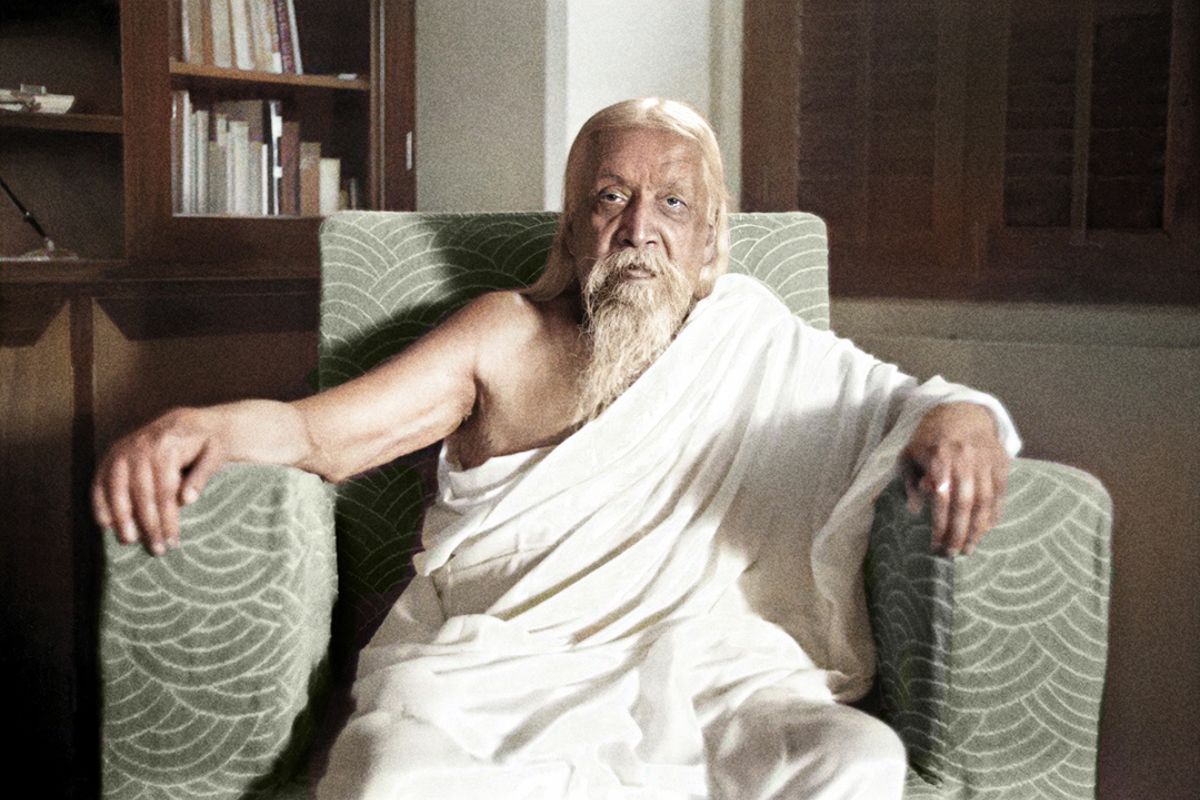
"Since his death in 1950, Sri Aurobindo Ghose has
been known primarily as a yogi and a philosopher of spiritual evolution
who was nominated for the Nobel Prize in peace and literature. But the
years Aurobindo spent in yogic retirement were preceded by nearly four
decades of rich public and intellectual work. Biographers usually focus
solely on Aurobindo's life as a politician or sage, but he was also a
scholar, a revolutionary, a poet, a philosopher, a social and cultural
theorist, and the inspiration for an experiment in communal living."
Peter Heehs has presented Aurobindo's story, and the driving ideas
behind his major works, with an academic neutrality that I appreciated.
It reminded me at times of Ramachandra Guha's Gandhi biographies - the
hint of the Gandhian in the author is unmistakeable, yet information is
presented in a straightforward manner covering all parts of the
subject's life without attempt to obscure or obfuscate for ideological
conformity.
This is a fascinating, detailed account of a
remarkable life that succeeds at presenting the thesis it starts off
with, chiefly that Aurobindo went through various transformative phases
in life where he played vastly different roles. This encompasses a
thoroughly British upbringing in England complete with English carers,
working tirelessly as a political revolutionary who believed in the need
to take up arms to free India from British occupation, and spending the
later half of his life in pursuit of elevating the very nature of his
existence through yogic practices.
My grandparents could probably
be described as believers who made regular trips from Gujarat to
Pondicherry for many years of their life. Entire almirahs of their
library were devoted to the storage of gigantic hardcovers authored by
Sri Aurobindo or The Mother, or works analysing their writings. Belief
and reverence in Sri Aurobindo and his mission have always been present
at the periphery of life, whether that is through blessing packets in
wallets or their portraits on the walls that still remain in my
grandparents' home long after they do not. My primary aim in seeking out
this book was to simply understand better that which captivated the
devotion of my family. Just as tantalising was the curiosity underneath
to discern the beliefs for merit, given how strongly my own have taken
hold in the past decade or so.
Before I delve into my personal
thoughts on the topic, an area of Aurobindo's life that I found
admirable: he produced an unparalleled amount of literary output which
few can claim to match. The merits of each of those might remain
debatable, but that does not erase the fact that his writing spans
thousands of pages on everything from plays, poetry, commentary on
philosophy, revolutionary tactics, musings on India's freedom struggle,
metaphysics, and academic interpretations of the Vedas, to his own
attempts at transcending the mortal plane. There are probably just as
many pages that were thrown in the bin or went missing, and ultimately
remained unpublished.
Aurobindo was also amongst the first to
proclaim nothing short of full independence from the British (preceding
Gandhi's demands for purna swaraj which came much later) at a time when
the dominant Moderates of Congress preferred to measure progress by each
minor concession they gained after years of lobbying. At such a time,
the idea of divorcing from the British empire completely was seen as
heresy by many, nigh impossible by others. In this, Aurobindo's vision
was truly ahead of its time.
Coming back to Aurobindo's spiritual
odyssey, and mysticism in general, I have found it terribly difficult
to take any of it seriously for the entirety of my thinking life. In
this particular case, the biggest obstacles are the prerequisite
beliefs: namely, that of the existence of a 'soul', and the existence of
a Creator (a nameless consciousness that permeates every object in
existence, if you prefer). If you do not believe in these, or are unable
to even entertain the possibility of higher realities than ours,
digesting Aurobindo's writings will prove difficult.
Frankly, a
lot of it is abstruse, but the gist of the philosophy is that evolution
is continuous, and we are not yet at the end. Just as life arose out of
matter, and consciousness evolved in life, the next step is the
evolution of our present consciousness into that of a higher kind, that
will deliver humanity into a better world than the one we find ourselves
in. It is not so much the promise of a utopia in the way that Heaven
is, rather a belief in the potential of a blissful state of oneness with
the Creator through yogic practices to the point that the question of a
body on Earth becomes immaterial.
While this sounds like a
reasonably harmless pursuit upon initial reading, the more you delve
into the literature, the harder it gets to put stock into. There is talk
of higher planes of consciousness, and how Aurobindo's yogic pursuits
allow him to hone what appear to us mere mortals as supernatural talents
(telepathy, visions of the past, present, and future, turning pain into
a source of pleasure, even the ability to manipulate world events) but
in reality are a result of progress on the path to elevating
consciousness to a higher level (or more accurately, bringing the
Overmind into the physical plane).
Aurobindo spent quite a few
decades in pursuit of his theory which, among many other fantastical
acts, allegedly granted him the ability to read and affect other
people's thoughts, intervene in major world events (he claimed to have
used his forces to aid the Allied cause in World War II), and
miraculously cure disease without any need of medical intervention.
The
only verifiable fact here is that Aurobindo passed away at 78 after a
deteriorating spell of illness that likely led to kidney failure. What
struck me was the certain belief amongst devotees right up to the end
that he was capable of fighting off advanced disease through his yoga.
Needless
to say, such ideas are quite dangerous in the Indian context. Without a
doubt, the notion of pursuing physical and mental perfection to fortify
one's sense of self is a noble one. But with this philosophy come a
host of beliefs that would do more harm than good. India does not need
more people believing that yogic pursuit is the sole key to physical
ailment, when we are already losing people to tantric healers and quack
Ayurveda vaidyas. India does not need even a hint of promise in
supernatural abilities when so-called religious healers are attracting
audiences in the thousands each day, promising a taste of just that.
India does not need to indoctrinate yet another generation into viewing
brahmacharya (celibacy) as a virtue, when millions have been repressed
sexually and pushed into arranged marriages out of custom for centuries.
In Aurobindo's case as in Gandhi's, their mission also
effectively sidelined their wives into submissive partners who were
expected to assent to their husband's will without any say in it
(Aurobindo spent most of his married life separated from his wife for
one reason or another - financial troubles, safety concerns - much to
her distress and disappointment).
In a country and a culture
that has been mired in superstition for millenia, and remains beholden
by babas and gurus to this day, it is no surprise that Aurobindo's ideas
gained credibility and mass following. Ideas that would sound ludicrous
to a rationalist, such as protracted spiritual practice and austerity
leading to supernatural powers in individuals, are not just entertained
but accepted as fact by a large section of the population. Aurobindo's
theories on this subject are informed through his exhaustive study of
Hindu scriptures while diverging from commonly held beliefs that such a
path required one to give up all worldly connections and become an
ascetic in the Himalayas. I imagine the familiarity certainly helped
Hindus to accept what Aurobindo was saying more easily than others would
have. It also helped that he had gained national notoriety and respect
as a revolutionary before he embarked on spiritual pursuits.
The
devotion of the people is ultimately unsurprising, after all Aurobindo
presents an enticing vision of greater purpose and possibility for
humankind in response to the gaping void left behind by the theory of
evolution and its upending of centuries of religious dogma. Yet this is
an unlikely vision for it has not produced any discernible results; in
the years since, the Indian spiritual movement has waned. Not much else
has changed. Wars are still being waged across the globe, children are
still dying, and no amount of yoga or meditation seems likely to deliver
us from the power hungry men who rule over the world. Perhaps in a
world such as ours, it is not entirely unimaginable a response to
withdraw inwards and chase deliverance within.
Comments
Post a Comment